

As Scuba Women, we understand the importance of safeguarding our skin against the elements while exploring the ocean’s depths. The sun’s rays, amplified by the water’s reflection and the ocean breeze, leave us vulnerable to sunburn. Scuba Women need to seek sun protection solutions that not only shield us from harmful UV rays but also preserve the delicate marine ecosystems we cherish.
For me, choosing the right sunscreen isn’t just about personal protection; it’s about safeguarding the delicate balance of marine life and coral reefs. I’m conscious of the ingredients in the products I use, knowing that what goes on my skin eventually ends up in the ocean. I want a sunscreen that protects and nurtures my skin without posing a threat to the environment.
Navigating the world of reef-safe sunscreens can be a challenge. Labels can be misleading, leaving us unsure of which products are truly eco-friendly. With terms like “natural mineral,” “sport,” “chemical,” “nano zinc oxide,” and “non-nano,” it’s easy to feel overwhelmed. Where does a Scuba Woman even begin her search for the perfect reef-safe sunscreen?
Join me as I delve into the world of reef-safe sunscreens, unraveling the intricacies of their composition and uncovering the best options for protecting both ourselves and the vibrant ecosystems we cherish.
It’s Never Too Late to Become a Confident Scuba Woman – Take the Dive with Me, Tanya.

Conscious of my fin print, I hope to simplify the process of selecting a reef-safe sunscreen. As a passionate Senior Scuba Woman, I advocate for brands committed to preserving our oceans by creating eco-friendly, reef-safe, sustainable, and ethical products. In this post, I highlight reef-safe sunscreens crafted by companies deeply dedicated to sustainability. With these brands, Scuba Women can shop with confidence, knowing they are supporting brands that strive to protect our precious blue planet.
Optimal Sun Protection Chemical vs Mineral Sunscreen
For optimal protection, choose a broad-spectrum sunscreen that effectively reflects or absorbs at least 90% of UV rays.
Conventional chemical sunscreens absorb the sun’s rays into your skin, triggering a chemical reaction under the skin, converting UVA and UVB rays into heat before releasing them. As that reaction occurs under our skin, our bodies absorb the chemicals. Chemical sunscreens containing oxybenzone and octinoxate deform young corals, damage DNA, disrupt reproductive cycles and endocrine systems, and cause coral bleaching; they are neither reef-safe nor people-safe.
Mineral sunscreens are safer options than chemical sunscreens. Rather than having a chemical reaction occur in your body, mineral sunscreens form a barrier on your skin to reflect UVA and UVB rays. The active ingredients in mineral sunscreen are non-nano zinc oxide or titanium dioxide. The FDA recognizes them as safe and effective.
Showering, swimming, snorkeling, scuba diving, surfing—14,000 tons of sunscreen washes into our coral reefs yearly. I always try to cover up rather than use sunscreen, but there are times when it is crucial to protect yourself from sun exposure.
It’s imperative to scrutinize labels and avoid sunscreens containing oxybenzone (benzophenone-3), octinoxate, homosalate, and avobenzone. By being vigilant in our sunscreen selection, we can actively contribute to the protection of our precious marine ecosystems.

A reef-safe sunscreen will not contain chemicals, nano particles, parabens, phthalates, artificial fragrances, or colors. When looking at your ingredient list, it is essential to look for non-nano particles. Nano particles are tiny particles that can leach into the water and hurt delicate ecosystems.
The Hawaiian-based, not-for-profit Haereticus Environmental Laboratory (HEL) sets the standard for reef-safe sunscreen and personal care products. If a sunscreen displays the Protect Land & Sea certification seal, it has been rigorously tested and found reef-safe. HEL holds companies accountable for the ingredients they use and continues to randomly test to ensure companies are maintaining reef-safe standards.
How Does a Scuba Diver Choose a Reef Safe Sunscreen?

Reef-Safe Sunscreen Explained
The mineral sunscreens below are broad-spectrum, protect and nourish your skin, and are safe for our oceans and all that dwell within them. Cover up as much as you can and apply sunscreen as necessary. Read the label. A good sunscreen’s active ingredients will be either non-nano zinc oxide or titanium oxide. Look at the botanicals and antioxidants in the non-active ingredients and choose your favorites to nourish your skin while protecting it from the sun.
The Ultimate Guide to the Best Reef Safe Sunscreen Brands
Stream2Sea
Stream2Sea is crazy for coral and committed to enhancing the health of our oceans with an extensive range of marine-friendly sunscreen and personal care products. Fellow Scuba Woman Autumn Blum founded Stream2Sea in 2015 after observing the slick of sunscreen swimmers left behind. Committed to enhancing the health of our oceans, Stream2Sea was born.
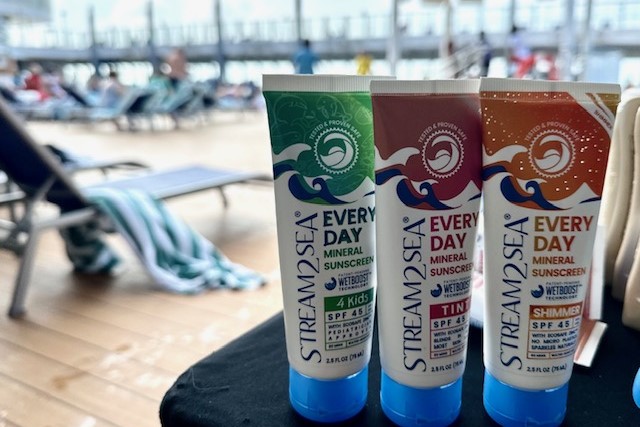
Stream2Sea sunscreen’s active ingredient is non-nano titanium dioxide, which offers protection from UVA and UVB rays. Non-active ingredients include green tea, tulsi, wakame, aloe, coconut oil, and olive leaf. The sunscreen absorbs quickly, isn’t greasy, and is water resistant for up to 80 minutes. Stream2Sea sunscreens are vegan and are kind to you, your skin, and the sea.
Stream2Sea is an eco-friendly business with a sustainable business model and a positive environmental impact. Creating their sunscreen tubes from sugar cane waste is a stroke of sustainability. Stream2Sea’s packaging is fully recyclable and eco-friendly. Stream2Sea products have been tested and proven safe for our reefs, marine life, and coral larvae.
Stream2Sea’s Sport Sunscreen SPF 30 is HEL Labs Protect Land + Sea certified.
Raw Love
Raw Love is proud to be Hawaii’s first FDA-compliant sunscreen company. Jenna Davis, Raw Love’s founder, dive master, and snuba instructor, wanted sunscreen to protect her sensitive skin, tattoos, and the ocean environment. With a background in marine biology and ocean conservation, Jenna used her knowledge to create a reef-safe, broad-spectrum sunscreen made from organic natural products.
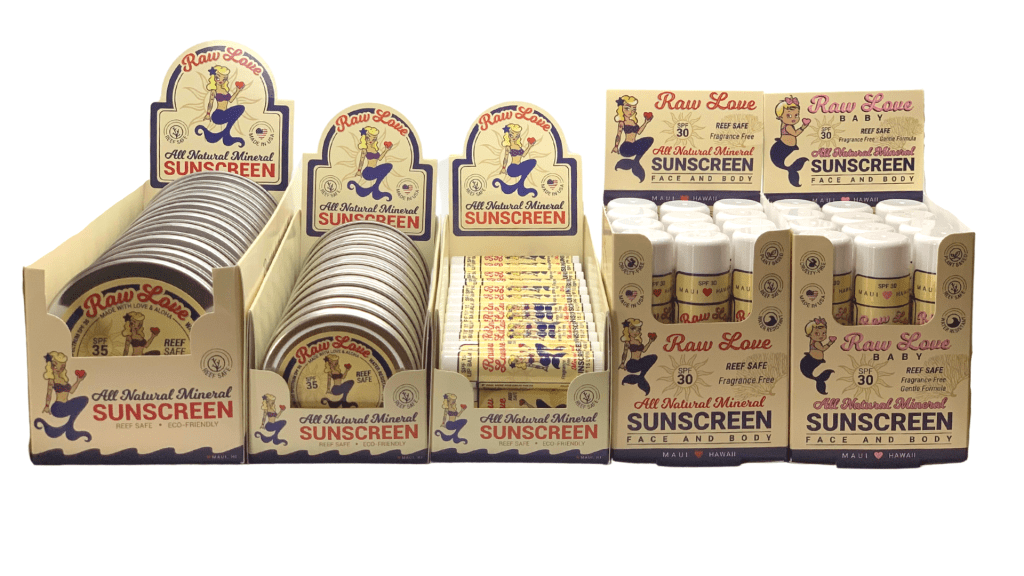
Raw Love’s active ingredient is non-nano zinc oxide, which is known for its skin-healing properties. Its luxurious nonactive cold-pressed ingredients include organic and plant-based unrefined coconut oil, raw shea butter, sesame oil, beeswax, jojoba oil, vitamin E oil, carrot seed oil, and pure essential oils: lavender, peppermint, and eucalyptus. Raw Love is a biodegradable and zero-waste sunscreen, perfect for Scuba Women with sensitive skin or tattoos.
Raw Love sunscreen goes on white and turns transparent when rubbed into the skin; a little goes a long way. I love Raw Love’s retro vibe and sultry-tattooed mermaid on their recyclable/reusable tin.
TotLogic
Totlogics founder Jill Taft’s mission is to spread “the benefits of using non-toxic products that make sense.” As a Scuba Woman, I am impressed Jill’s first scuba dive was on the beautiful but potentially dangerous Blue Hole in Dahab. Still passionate about scuba, Jill promises to keep her products “pure, simple and authentic.”
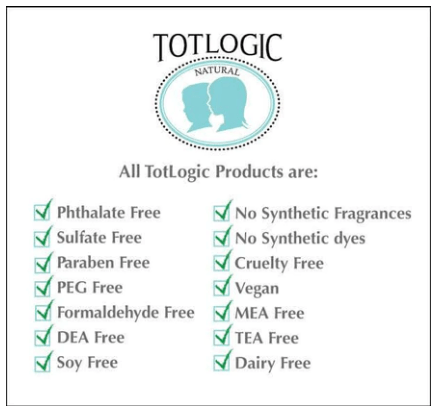
Totlogics SPF 30 Mineral Sunblock is a broad-spectrum sunscreen; its active ingredient, non-nano zinc oxide, is a known skin protectant. As a diver, I appreciate its thicker consistency and the 80 minutes of protection it provides me in the water. TotLogic Sunscreen is eco-friendly, reef-safe, non-toxic, and biodegradable.
TotLogic is ideal for scuba women with sensitive skin. It can be worn daily under makeup. Its rich ingredient list includes antioxidants arnica, white tea, chamomile, and lavender, as well as hyaluronic acid, aloe, and jojoba, which protect and nourish your skin. TotLogic is vegan-safe, cruelty-free, and non-nano. It is rated as a tear-free sunscreen and may be used on children as young as 6 months.
TotLogic Reef Safe Natural Sunscreen is rated #1 on EWG (Environmental Working Group).
Raw Elements
Discovering how harmful sunscreens were to people and marine life was the motivation that inspired Raw Elements. Founder and ocean lifeguard Brian Guadagno wanted to create a sunscreen both safe for ocean lovers and the ocean.
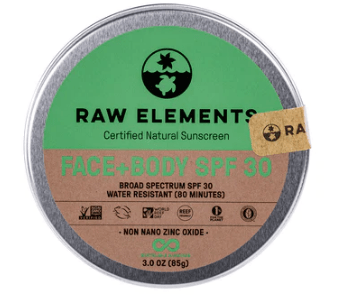
The active ingredient in Raw Elements sunscreen is biodegradable non-nano zinc oxide. Broad-spectrum and water-resistant for up to 80 minutes, Raw Elements is a good choice for the eco-conscious Scuba Woman. It can even be applied underwater. All other ingredients are certified natural or organic. It is hypoallergenic, fragrance, and preservative-free, offering protection from sun, salt, and wind.
Zero-waste and plastic-free packaging: Raw Elements is packaged in recyclable/reusable tins or bio-resin tubes. In 2019, Raw Elements also founded World Reef Day. This yearly event helps raise awareness of the fragility of our ocean ecosystems. It is a day when many ocean champions come together to find ways to protect our at-risk oceans and reefs.
Raw Elements Sunscreen is rated #1 on EWG (Environmental Working Group).
Badger
Badger is a family-run business and a safe sunscreen pioneer. Badger continues refining their formulas, always striving to create healthy, healing products. When EWG (Environmental Working Group) first published a guide to safe sunscreens, Badger ranked at the top. Their manufacturing process is powered by solar, and their non-active ingredients are organic, non-GMO, gluten-free, plant-based, and certified cruelty free.
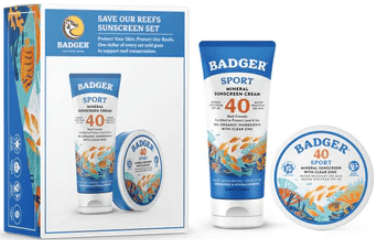
Badger keeps its sunscreen components clean and straightforward, with uncoated zinc oxide as its active ingredient. Organic sunflower oil, organic beeswax, jojoba, and sunflower vitamin E enrich its waterless formula, making it reef-safe and rich in antioxidants. Badger sunscreens are packaged in a recyclable/reusable tin or 50% PCR tubes.
A certified B corporation, Badger carries the Protect Land and Sea certification and is rated #1 EWG (Environmental Working Group).
SunButter
Sacha Guggenheimer and Tom Hiney were working and diving with whale sharks on the stunning Ningaloo Reef, Western Australia when they first had concerns about the sunscreen they were using. Essential in the harsh Western Australian sun, Sarah & Tom were aware of the potential harmful impacts regular sunscreen was having on the World Heritage-listed Ningaloo reef.

SunButter was initially handmade for the smaller community but has now expanded to become Australia’s “first reef-safe sunscreen packaged in reusable and recyclable tins and Australia’s first vegan surf zinc.”
SunButter’s active ingredient is non-nano zinc oxide. All plant-based, nonactive ingredients are sustainably sourced and palm oil-free. SunButter is plastic-free, and the non-aqueous solution means your sunscreen goes further and lasts longer. SPF50 SunButter is perfect for Australian conditions and is water-resistant for four hours. It can be worn under makeup and is excellent for sensitive skin.
An all-around good company, SunButter products are made in Australia in a solar-powered factory and are carbon neutral. Sunbutter gives back 50% of their profits to help save the planet. SunButter also supports Living Culture’s brilliant initiative, educating “people about the importance of keeping Aboriginal culture alive.”
SunButter is approved and registered by the Therapeutic Goods Administration and also has a range of natural skin care products.

As a Senior Scuba Woman, my aim is to empower women to dive with confidence while making eco-conscious decisions in their daily lives. I believe that living sustainably and preserving our environment should be simple and accessible. That’s why ensuring the use of reef-safe sunscreen stands as a top priority on my list of sustainable practices.
IT’S NEVER TOO LATE -TAKE THE DIVE WITH ME, TANYA – HELPING WOMEN DIVE CONFIDENTLY
Want to be part of our powerful community? Subscribe to receive the latest posts straight to your inbox and join other women scuba diving with confidence 🤿🤿🤿
If you liked this post or any other please feel free to share using the buttons below
 Empty Nest Diver