
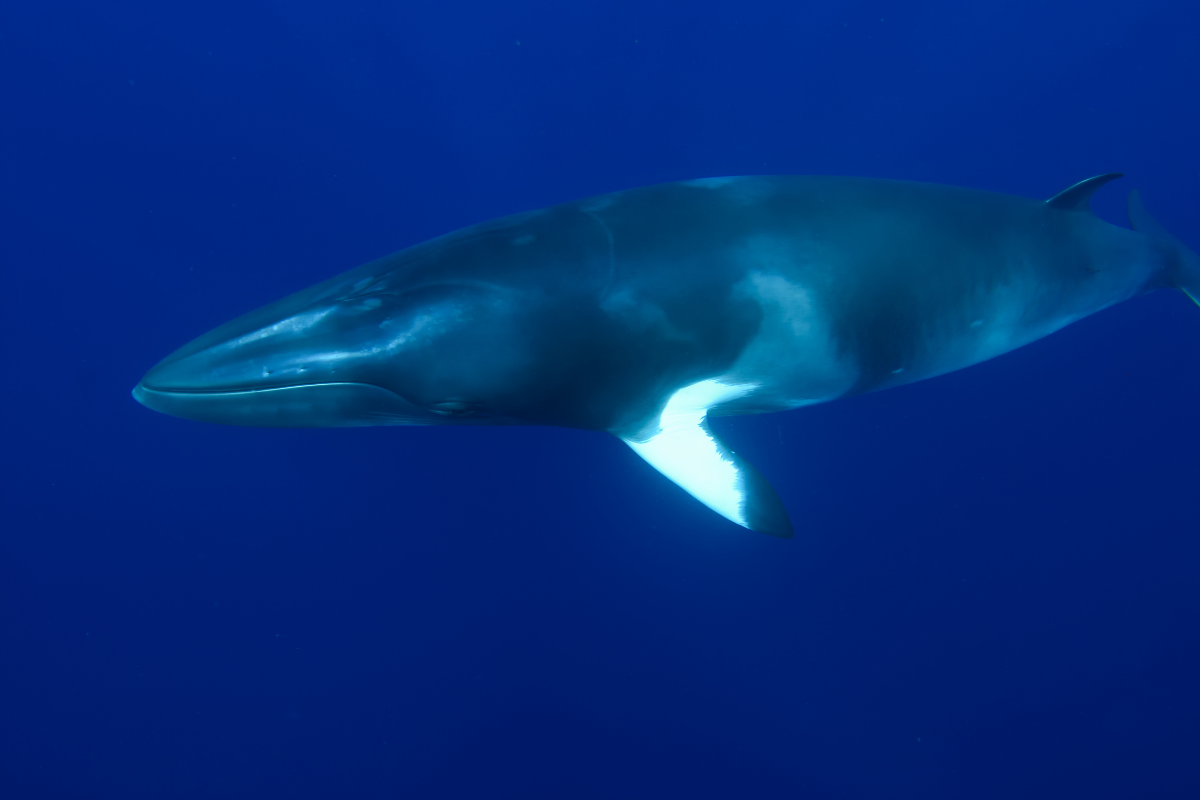
During the Australian winter, on the Ribbon Reefs of the Great Barrier Reef, there’s a brief window, from June to July, when a fortunate few can experience the wonders of swimming with Dwarf Minke Whales. With only a handful of licensed operators offering this sought-after experience, securing your spot well in advance is advisable. I am fortunate to have a berth on The Spoilsport, Mike Ball’s custom-built dive boat. Anticipation builds as I eagerly track weather updates, follow Mike Ball’s reef reports, and immerse myself in footage from previous journeys. I can barely wait to be up close and personal with the whales.
Amidst the thrill of the opportunity to be in the water with these 6-tonne mammals is an unexpected and life-changing delight. Dr. Alastair Birtles is on board the Spoilsport to share his knowledge and expertise. A dedicated conservationist and foremost authority on these magnificent creatures, Dr. Birtles’ presence enriches the adventure in ways I could never have imagined.
It’s Never Too Late to Become a Confident Scuba Woman – Take the Dive with Me, Tanya.
Table of Contents
- Dwarf Minke Whales on the Ribbon Reefs Great Barrier Reef
- Aboard Mike Ball’s The Spoilsport, Swimming with Dwarf Minke Whales
- Dwarf Minke Whales and Their Hero Dr. Alastair Birtles
- Discovering Dwarf Minke Whales on the Great Barrier Reef
- Sustainable Minke Whales Tourism on the Great Barrier Reef
- Interacting with Dwarf Minke Whales on the Great Barrier Reef
- Partial and Full ID’s Dwarf Minke Whale Research
- The Dwarf Minke Whales are on the Great Barrier Reef
- A Scuba Woman & Dwarf Minke Whale Intimately Connect
- Licensed Snorkel and Dive Tours with Dwarf Minke Whales
Dwarf Minke Whales on the Ribbon Reefs Great Barrier Reef
Aboard Mike Ball’s The Spoilsport, Swimming with Dwarf Minke Whales
Mike Ball’s Spoilsport is the perfect vessel for our liveaboard. It soon becomes home with comfortable cabins, delicious meals, and a spacious dive deck. Our cabins are easily accessible from the dive deck with a hot shower and air conditioning. Photographers have ample room for their camera equipment, the crew is always on hand to help, and gearing up is easy.
When booking with Mike Ball, you have the opportunity to opt for nitrox diving. As a seasoned Senior Scuba Woman, I always choose nitrox for multiple dives. It aids in reducing fatigue and allows for longer dives with shorter surface intervals. PADI provides a specialized course, PADI Enriched Air (Nitrox), for those interested in exploring this option further.
Dwarf Minke Whales and Their Hero Dr. Alastair Birtles
On board the Spoilsport to share his knowledge and study the Dwarf Minke Whales, Dr. Alastair Birtles’s approach to conservation is measured and genuine, his knowledge undeniable. Dr. Birtles only wants the best outcome for the marine animals he studies. Alastair also recognizes tourism’s value in supporting his conservation and research efforts. Responsible for the Code of Behaviour around many tourism and animal interactions, the protocols he has instigated make for an enjoyable experience, keeping both animals and humans safe. Through him, I have learned and broadened my understanding of conservation and my role in preserving and protecting the reefs and their inhabitants.
Discovering Dwarf Minke Whales on the Great Barrier Reef
One of the first scientists to discover the Dwarf Minke Whales on the Great Barrier Reef in the 1980s, Dr. Birtles was born in England and initially studied zoology at Oxford University. Even in his formative years, Alastair exhibited a deep-seated commitment to environmental causes, immersing himself in travels and engagements across developing nations. I envision a youthful Alastair, with a backpack slung over his shoulders, absorbed in his studies, teaching, and relishing in the wonders of nature. For him, the outdoors was not just a destination but a sanctuary, the beach akin to his bedroom. Passionately sharing his knowledge, delivering lectures under the evening sky, before carefully rolling his suit away in his backpack to prevent creases and retiring for the night under the starlight skies.

Sustainable Minke Whales Tourism on the Great Barrier Reef
Alastair later studied marine biology at James Cook University and is now based in Townsville. He is a forerunner in finding the delicate balance between sustainable tourism and conservation—whale sharks, sharks, whales, dolphins, turtles, and dugongs have all come under his protection. His considered approach has broadened my understanding of conservation and the importance of protecting our reefs and their inhabitants. The Minkes are incredibly lucky to have Dr. Birtles in their corner of the ocean.
Mike Ball’s Minke Whale expedition visits many incredible dive sites on the Ribbon Reefs. Any Scuba Woman would love diving Lighthouse Bommie, the famous Cod Hole, and Steve’s Bommie. In his seventies, Doctor Birtles is still an active scuba diver (something else to be admired). Rather than dive these stunning and pristine dive sites, Alastair elects to remain on the top deck watching for Dwarf Minke Whales. He feels an obligation to the Minkes; his commitment is undeniable.
Dr. Birtles’s gentle manner reflects his respect and love for these unique animals. After more than twenty years of studying the Dwarf Minke Whale, Alastair still considers his interactions a privilege. His evident love, sensible approach, and care for our aquatic world are impressive.
Interacting with Dwarf Minke Whales on the Great Barrier Reef
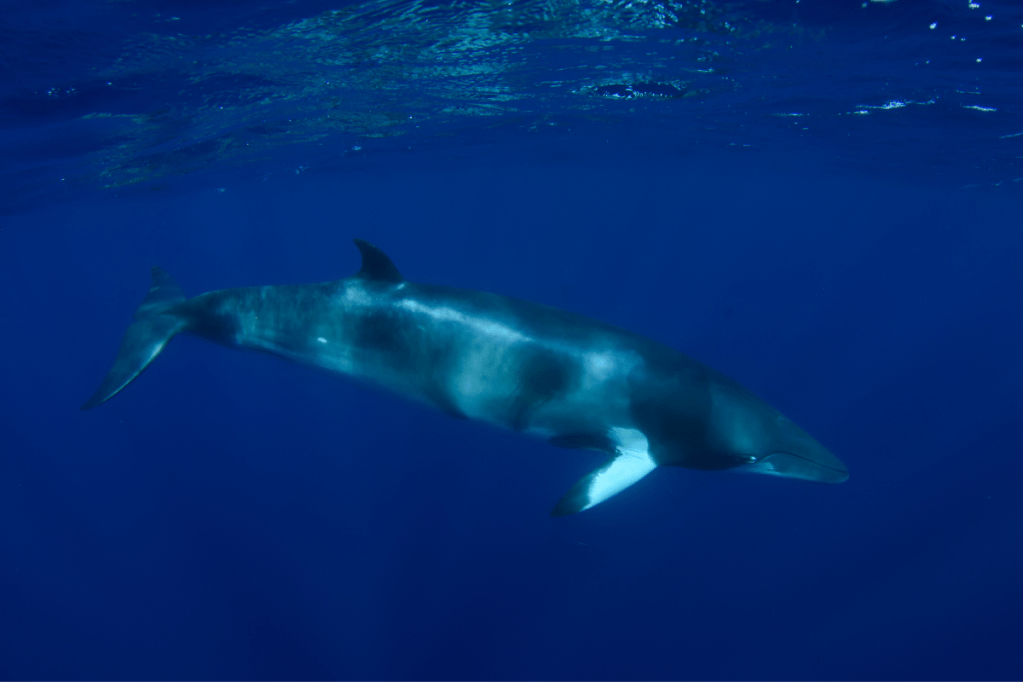
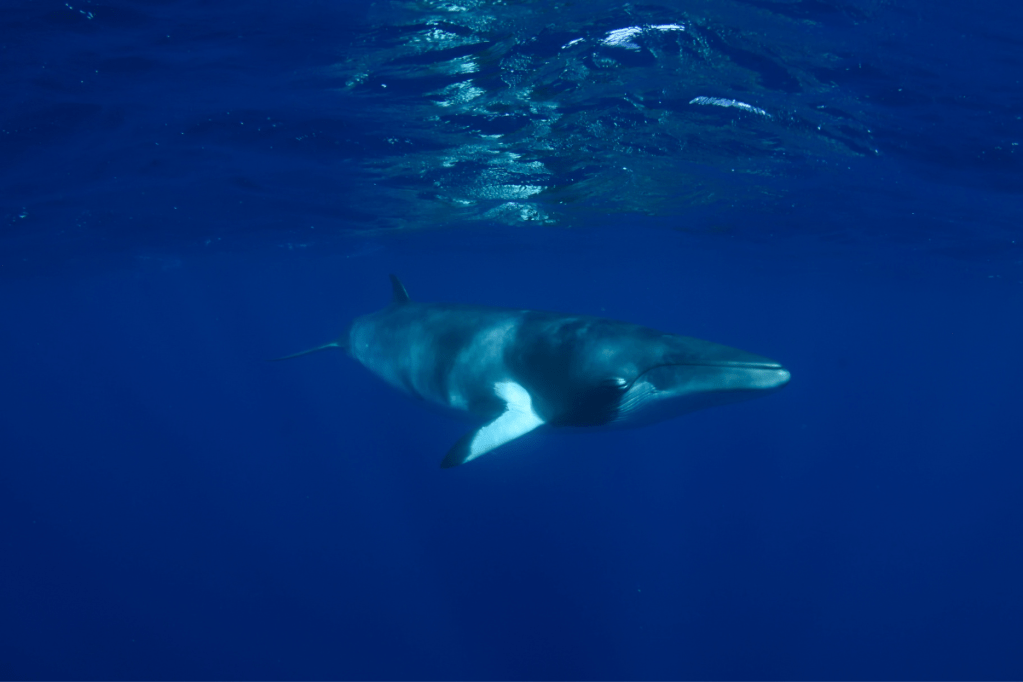
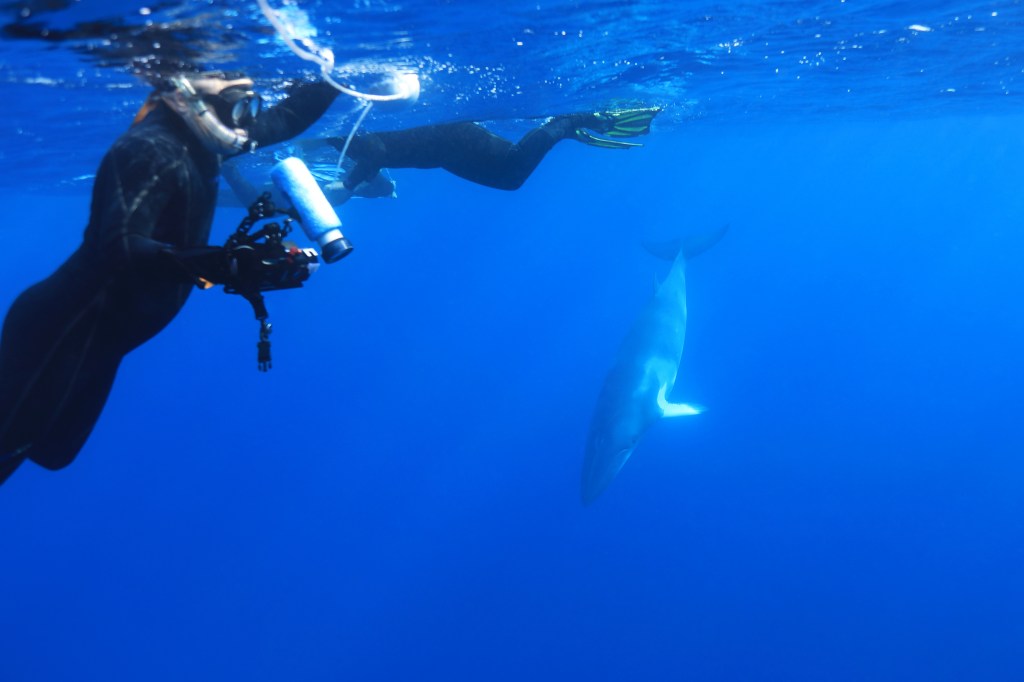
Our interactions with the Dwarf Minkes are at the whale’s discretion. The protocols are straightforward –the whales must approach the boat and us. It is illegal in Australia to swim toward a whale. When the Minkes are in the area, we quietly slip into the water, holding onto lines from the boat. We wait and hope for an encounter. The rules are firm; at no stage are we to swim or dive after the whales. Luckily, the Dwarf Minkes are curious and choose to spend several hours swimming around the boat and interacting with us.
Alastair outlasts us all in the water. The detail of his research and the data he collects is astounding. Alastair values our inclusion, asking us to donate any photos or videos we take to the Minke Whale Project. The hours and hours of footage will keep many graduate students busy for a very long time.
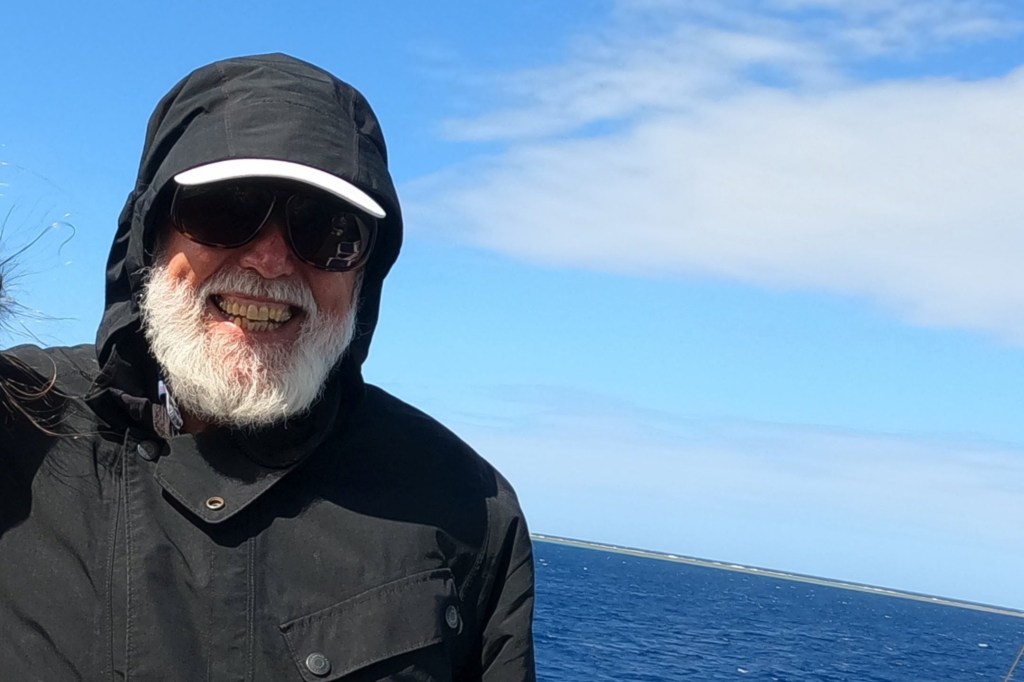
Alastair talks of the whales as friends, distinguishing their markings and personalities with affection. Later, as we relaxed in the comfortable saloon, Alastair explained his drawings, which he had completed during our encounters; I was amazed by their detail. The Spoilsport is moving, the line is moving, the water is moving, you are moving, and 6-tonne Dwarf Minke Whales are moving around you. Somehow Alastair manages to note the Minke’s features and record their behaviors and characteristics. Our encounters often last for hours, and the ocean is choppy at times. Alastair not only remains in the water with his friends, the Minkes, but he also completes comprehensive depictions identifying individual whales.
Partial and Full ID’s Dwarf Minke Whale Research
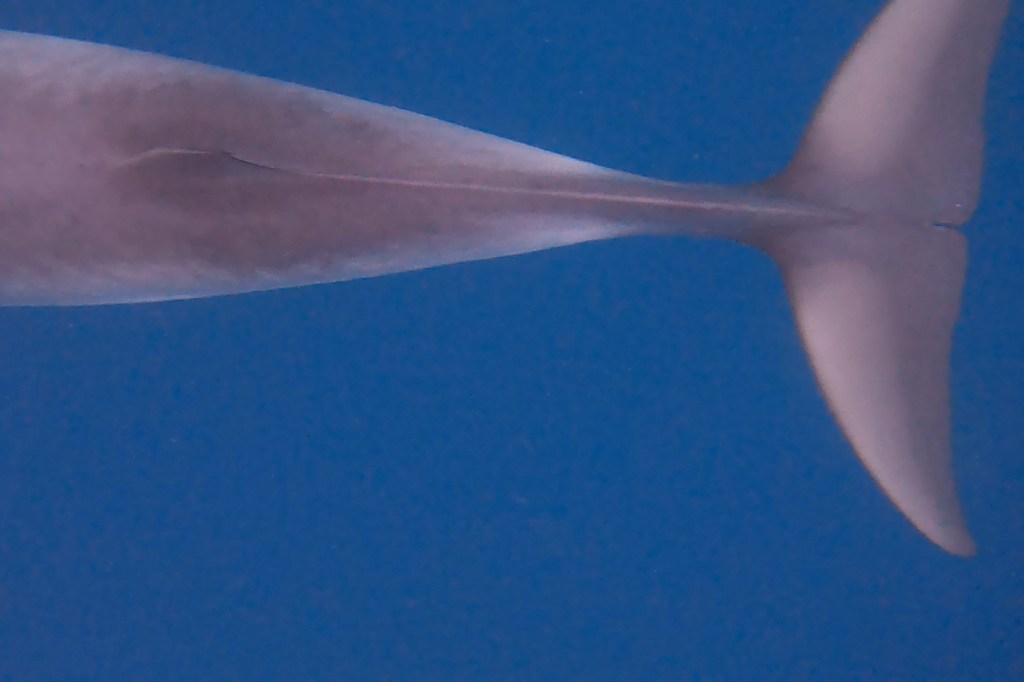
Under Alastair’s guidance, I begin recognizing different whales’ markings and excitedly complete a partial ID. (identifying one side of the whale). It is a complicated process; each dorsal fin is like a fingerprint, with no two markings the same. The left and right sides of the animal differ, complicating the identification process. Identifying and matching both sides of a Dwarf Minke is a complete ID, something I couldn’t quite manage. Approximately one-quarter of whales sighted each year have been sighted in previous years. Many approach different vessels throughout the Dwarf Minke season.
Listening to Alastair talk, I am struck by the kinship. He knows many of the whales intimately, regaling us with a story of a whale he met years ago named Trumpet. They crossed paths another year, and he chuckled as he relayed her provocative tummy roles. Apparently, she was quite an exhibitionist, earning her the nickname Strumpet.
Doctor Alastair Birtles does not believe the Minkes recognize him. I am not so sure; they are obviously curious, intelligent creatures. If he can identify them, I think they can remember him; they indeed stayed around even when Alastair was the only person left in the water. I personally believe Strumpet was showing her pleasure at seeing him again.
The Dwarf Minke Whales are on the Great Barrier Reef
There are two species of Minke Whales: the Northern Minke Whale/Common Minke Whale (Balaenoptera acutorostrata) and the slightly larger Antarctic Minke Whale/Southern Minke Whale. (Balaenoptera bonaerensis). Dwarf Minke Whales are believed to be a subspecies of the Common Minke Whale and are found in the Southern Hemisphere. A baleen whale, Dwarf Minke Whales are the second smallest whale, the Pygmy Whale being the smallest.
The lead researcher of the Minke Whale Project, Dr. Birtles, ensures research is about the safety and well-being of the whales. Collecting data and information for the Minke Whale Project is never to the whale’s detriment. Researchers know the Minkes aggregate in the warmer waters of the Ribbon Reefs for 6 to 8 weeks in winter before disappearing into the blue.
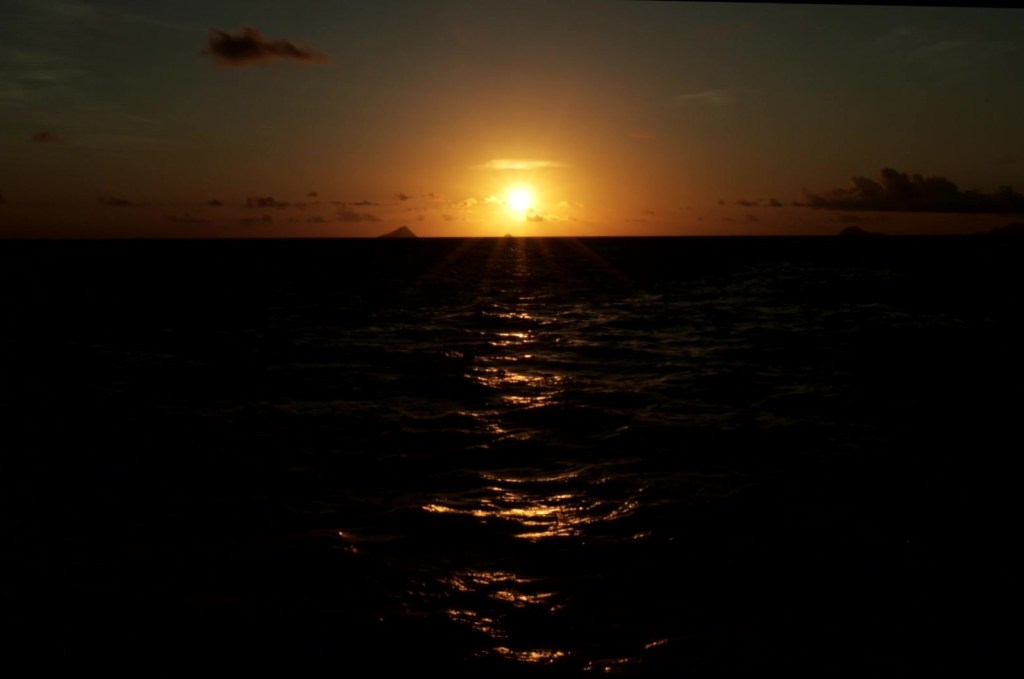
The lead researcher of the Minke Whale Project, Dr. Birtles, ensures research is about the safety and well-being of the whales. Collecting data and information for the Minke Whale Project is never to the whale’s detriment. Researchers knew the Minkes aggregated in the warmer waters of the Ribbon Reefs for 6 to 8 weeks in winter before disappearing into the blue. Alastair patiently waited for the development of a smaller dart to track the migration of Dwarf Minke Whales, ensuring minimal discomfort for these majestic creatures. Through meticulous data gathering, they discovered the remarkable journey of the Minkes to the Antarctic. Armed with the necessary insights, they made the decision to halt the darting process, having achieved their research objectives.
A Scuba Woman & Dwarf Minke Whale Intimately Connect
The whale encounters are indescribable and magnificent, more than anything I could have hoped for….. and I was hoping for a lot.
There’s a moment when our eyes meet, mine and the whale’s. It’s a soul-stirring experience, one that etches itself into my memory forever. In that instance, it seems like we transcend time itself as we share a profound connection. My heart swells with emotion, and I feel a deep sense of gratitude. It’s not just a visual encounter; it’s a visceral experience that consumes my entire being. I find myself completely immersed in the whale’s gaze and presence. Eventually, the whale gracefully swims beneath me, so close I could reach down and touch it. It’s a privilege, a very close encounter with a Dwarf Minke Whale, the intimacy of the moment remaining with me still.
I also have moments listening to Alastair speak so genuinely. His approach to conservation has inspired me. The research is important – the animal is more important. He also understands the importance of managing tourism around these encounters and has set guidelines to ensure a positive experience for both animals and humans. He is a gentle man, with an enormous reverence for all that this wonderful planet has to offer.
Licensed Snorkel and Dive Tours with Dwarf Minke Whales
My advice to anyone wanting to experience an interaction with these curious baleens is to book early. Only a few operators are licensed to conduct snorkel and dive tours to swim with the Dwarf Minke Whales. There is plenty to see on the liveaboards for both snorkellers and divers. I could not fault Mike Ball Dive Expeditions and have booked a year ahead for their Turtle Spectacular.
To learn more about the Dwarf Minke Whales, visit minkewhaleproject.org and Dr Alastair Birtles
IT’S NEVER TOO LATE -TAKE THE DIVE WITH ME, TANYA – HELPING WOMEN DIVE CONFIDENTLY
Want to be part of our powerful community? Subscribe to receive the latest posts straight to your inbox and join other women scuba diving with confidence 🐳🐳🐳
If you liked this post or any other please feel free to share using the buttons below
 Empty Nest Diver